
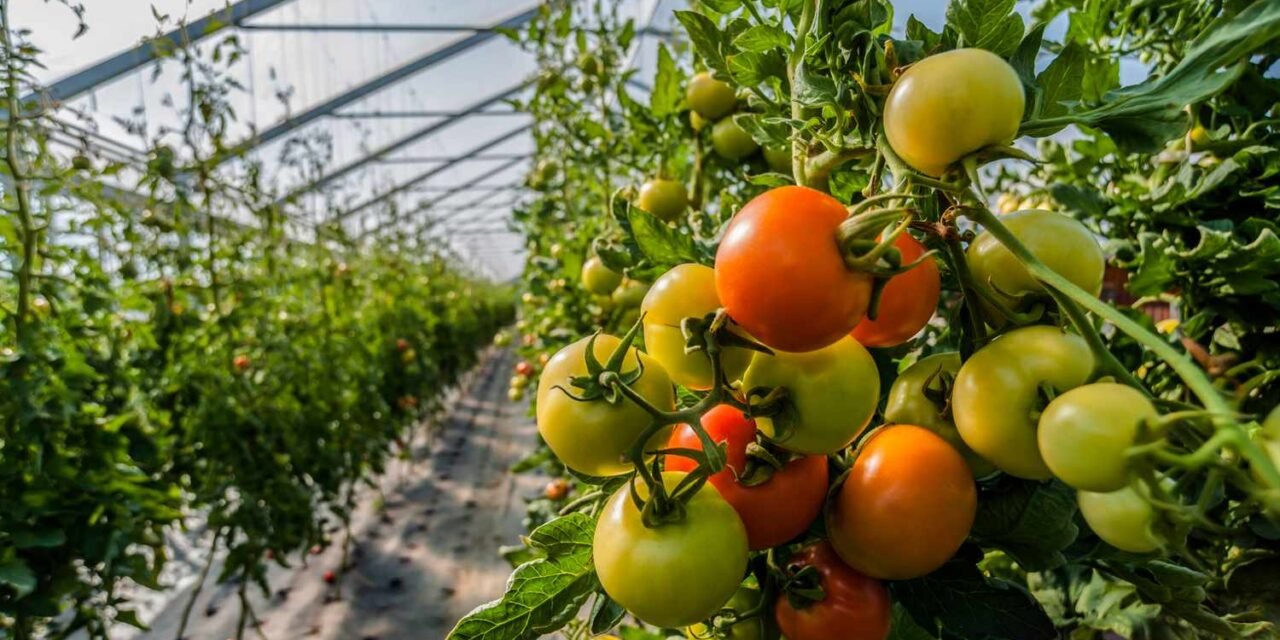
Tomatoes are beloved within the U.S., however drought and local weather change threaten their provide.Hydroponics and vertical farming may use as much as 90% much less water whereas producing high quality tomatoes.Excessive prices and labor wants restrict progress, however greenhouses may form the way forward for farming.
From ketchup on burgers to the sauce on pizza, tomatoes discover their means into lots of America’s favourite meals. In actual fact, tomatoes are one of many most-eaten greens within the U.S., second solely to potatoes. The common American eats greater than 30 kilos of them every year. As a result of they’re full of the antioxidant lycopene, consuming tomatoes often generally is a main boon to your well being, whether or not you slice them up recent or add them sun-dried to your favourite recipe.
Though they originated in South America, the favored veggies turned a phenomenon almost all over the place on the planet within the second half of final millennium. Right now, beloved tomato recipes span the globe, from shakshuka to pico de gallo.
By some estimates, about 30% of the world’s tomatoes, roughly 26.4 billion kilos yearly, are grown in California. However since 2022, droughts, some fairly extreme, have threatened this particularly water-intensive crop. “The tomato is what we name a heavy feeder,” says Joe Masabni, Ph.D., a professor and extension specialist on the Texas A&M AgriLife Analysis and Extension Heart. “It wants a variety of water and a variety of fertilizer for an optimum crop.”
With local weather change anticipated to extend the frequency and severity of droughts—and doubtlessly develop drought-prone areas—tomato manufacturing may face even higher challenges within the years forward. Thankfully, agricultural scientists are engaged on modern options to assist be certain that tomatoes can proceed to thrive, even when water is scarce.
The Promise of Indoor Farming
Daniel Wells, Ph.D., an affiliate professor of specialty crops at Auburn College in Alabama, has been rising tomatoes hydroponically—utilizing a nutrient-rich water answer as a substitute of soil—for almost a decade. His analysis focuses on serving to farmers undertake extra water-efficient rising strategies.
Hydroponic techniques, particularly these in managed environments like greenhouses or vertical farms, can considerably scale back water use. Whereas it could sound counterintuitive that rising a crop in water makes use of much less water than a crop grown in a farm subject, it’s true—tomatoes grown hydroponically want 80% to 90% much less water than these grown in fields. This effectivity comes from recycling water by way of the techniques, somewhat than water operating off fields or evaporating.
That degree of management is one only one advantage of rising tomatoes hydroponically. “One other benefit to greenhouse manufacturing could be native manufacturing,” explains Wells. “You don’t develop tomatoes in Canada year-round, except you may have a greenhouse, proper? It reduces seasonality, and it additionally will get that produce nearer to the patron, so the transportation distance is shortened.”
Masabni additionally highlights vertical farming as one other innovation that conserves each house and water. As an alternative of spreading out over massive fields, hydroponic techniques will be stacked vertically—utilizing cabinets or tubes—permitting growers to provide extra meals in a smaller footprint with much less water, too.
The Environmental & Financial Commerce-Offs
So why aren’t extra farmers rising tomatoes indoors? Based on Wells, it largely comes all the way down to value. He quotes an preliminary value of between $1 and $3 million per acre to construct a high-tech greenhouse, and says they’re an “energy-intensive” endeavor, as heating and cooling is one other main expense. By some estimates, this makes greenhouse operations three to 5 occasions dearer to run than a typical farm. Labor additionally presents an elevated value. As a result of hydroponic techniques are extremely specialised, they demand expert employees who perceive learn how to function and preserve the tools. “On the subject of the most important expense, I do not know if labor is No. 1 or electrical energy is No. 1,” says Masabni. Universities like Auburn and Texas A&M are coaching new leaders within the subject, however each consultants agree {that a} lack of expert labor is one other hurdle for indoor farmers.
Moreover, hydroponically grown tomatoes are offered at a premium, typically over $3 to $6 per pound in comparison with $1 to $2.50 per pound for field-grown tomatoes. Nevertheless, for shoppers, the payoff could also be price it—notably on the subject of taste. Wells shares that rising in greenhouses can result in a higher-quality, extra constant product. “Greenhouse manufacturing permits us to get [tomatoes] actually near vine-ripened, after which to the patron inside a day or two. I really like the tomatoes that we develop within the greenhouse at our analysis facility, however I additionally purchase greenhouse-grown tomatoes on the grocery retailer as a result of they’re simply higher,” he says.
Masabni provides that high quality goes past style. “We’re breeding for greater high quality, so I hope what’s coming down the road might be confirmed to have extra antioxidants and extra nutritional vitamins, not simply higher style. Hopefully the dietary high quality will assist justify the upper value.”
Is Indoor Tomato Farming Scalable?
Masabni and Wells point out the Netherlands and Spain as world leaders within the observe, and Wells applauds Canada, name-checking Nature Recent Farms, Pure Taste and Purple Solar Farms. Nearer to house, Auburn College has its personal profitable mannequin, referred to as “Meals U.” The college’s growers preserve some tomatoes for analysis, however use the remainder to provide campus eating services and native eating places, together with different greens grown on the faculty’s services.
Nonetheless, the U.S. has but to totally embrace indoor tomato farming. As an alternative, the trade has discovered extra traction with leafy greens. The explanation? Greens require so much much less mild to develop, making them extra sensible for totally indoor techniques. Tomatoes, then again, are a special story. “Even for those who had been in a position to produce sufficient mild for a tomato plant, you’d have an incredible quantity of warmth that you must handle. Tomatoes simply don’t make sense in a totally indoor system. They make a lot, far more sense in a greenhouse, the place you may have some management over the atmosphere, however you’re using free daylight,” Wells explains.
Our Knowledgeable Take
So is rising tomatoes indoors the reply to a drought-ridden world? “In the long term, sure,” says Masabni. “A greenhouse-controlled atmosphere is the answer, as a result of the expertise will enhance and develop into extra environment friendly, recycling each drop of water. Sooner or later, it’s promising—however perhaps not now.” Due to instructional and analysis packages like his, we’re getting nearer day by day to large-scale indoor tomato farming being a worldwide actuality.
Supply hyperlink